
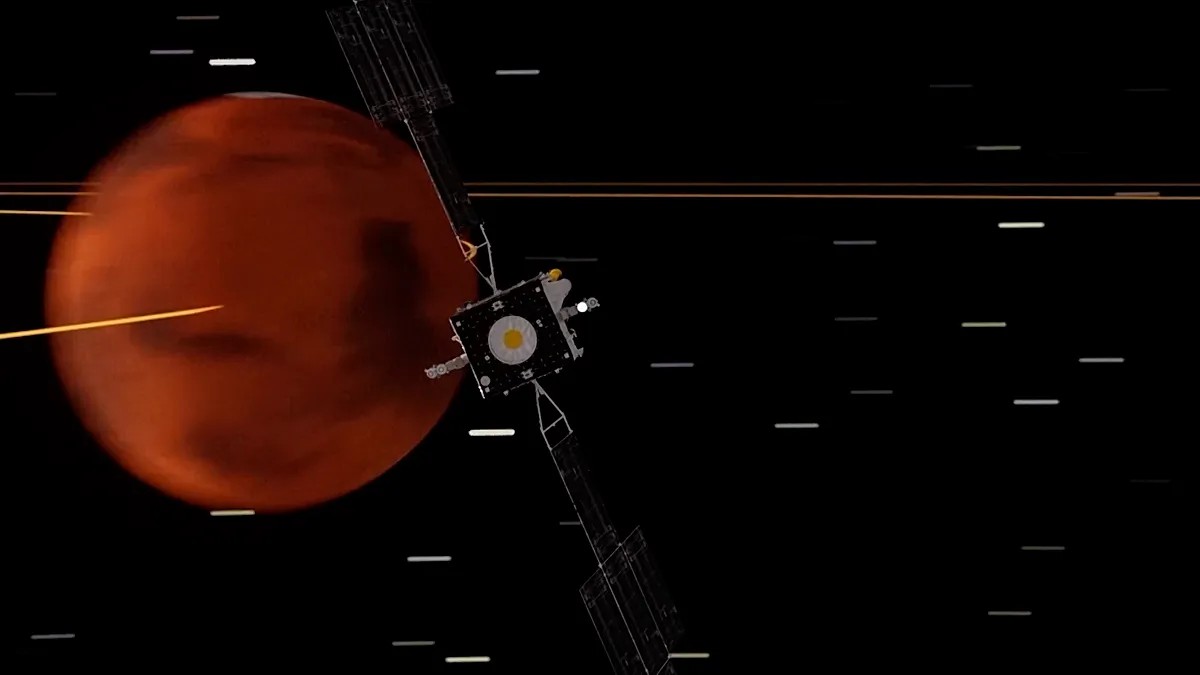
It is going to be quick. Very quick.
Friday brings the close approach. The Psyche spacecraft isn’t stopping for gas. Or sightseeing. Not really. It’s using Mars’s gravity like a slingshot to fling itself toward an asteroid belt target that sounds like it belongs in a sci-fi movie.
Here is the thing about Psyche (the rock, not the myth). It’s not like other asteroids. Those are usually dusty piles of ice or dirt. This one is a massive ball of metal. Scientists think it might be the bare core of a planet that got smashed to pieces billions of years ago.
If we want to know how Earth got its heavy, molten heart, we look here.
“For instance, Earth orbits around the sun… So you can make a plane change… And that’s very expensive if you do it by rocket.”
That’s Don Han from the JPL Navigation team. He’s talking about the math of changing orbital planes. Rockets burn fuel to do that. Mars? Mars just does it for free.
The craft will scream past the Red Planet at roughly 19,840 km/h.
It’s not a distant look. Psyche will pass within 4,500 kilometers of the surface. Fast. Blurring fast.
As it dives in, the cameras are rolling. Right now, Mars looks like a sliver. A crescent. After the flyby snaps complete, it’ll look almost full in the rearview. It’s a great chance for engineers to toggle every instrument on. Test the gear. Check the angles.
Meanwhile, back at Mars itself, NASA’s rovers are waiting. The Curiosity and Perseverance rovers? They’ll snap shots too. Several orbiters—American and European alike—are also watching. It’s a coordinated glance. If Psyche looks a certain way to the flyby ship and another way to the stationary orbiters, that’s good data.
The mission started in 2023. Seven years in total. We’re at the halfway point.
2029 is when we actually arrive at the asteroid. Then? We orbit for two years. Slowly. Studiously.
Why this metal lump matters:
- Origin story: It might be a planetesimal from the solar system’s infancy.
- Composition: Only a tiny fraction of the millions of rocks in the asteroid belt are this dense with nickel-iron.
- Age: Discovered in 1852. Observed for 170 years. It is arguably one of the oldest objects we have eyes on.
Libby Jackson from the Science Museum put it simply.
“I’m certain that whatever it is will… tell us more about the evolution… of the Earth.”
She’s not just guessing. Nobody has flown to this stuff before. No ship has ever touched a big lump of metal out there.
The distance changes constantly. Psyche waltzes around the sun at its own pace. Sometimes it’s close enough to worry about impact. Other times it’s 372 million miles out of reach.
Right now? It’s 280 km wide. Roughly the size of Arizona’s northern half. But it’s what’s inside that counts. Or what was inside, before the crust tore off.
We’re still waiting on the answer.
Will it confirm our models? Or will it break them entirely?
The flyby happens. The gravity assist works. The ship moves on. We wait.