
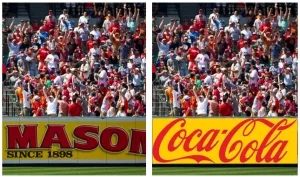
Band advertising at major sporting events isn’t a new concept. It has been standard practice for decades. But this year is different. The UEFA European Championship is using a technical solution that makes banners adapt to the viewer’s location. This means you see one ad in Germany and another in the UK.
Why does this matter to you? It changes how global sports are consumed. The technology allows sponsors to target specific regions without physical changes to the stadium. Deutsche Bahn might appear on boards in Germany. A fast-food chain might appear in another country. This is possible through artificial intelligence.
The Mechanism Behind Virtual Banner Ads
The idea of location-adapted advertising is not new. Formula 1 races use it. Ice hockey leagues use it. The method involves AI-driven overlays. These overlays cover the real physical banners in the stadium. They appear only on the TV screen.
In the stadium, fans see what is physically there. In the UK, Spain, or non-European countries, they see something else. Sometimes the text is just translated. Chinese viewers might see a Coca-Cola ad in Chinese characters. But the key difference is which ads are shown. Deutsche Bahn ads do not appear in other countries. This is a direct result of the technology.
Technical Challenges and AI Processing
The system faces constant hurdles. Players often run into the advertising boards. When this happens, the AI must act quickly. It needs to recognize the person. It then removes them from the image. Without this speed, players might disappear from the screen.
The AI also calculates perspective. It identifies which part of the field the camera is filming. This allows the ad to be inserted correctly. The overlay must match the angle of the shot.
Historically, this required heavy hardware. Teams used specialized camera heads. These tracked camera movement with precision. The boards emitted an infrared signal. This signal acted like a green screen. It created an additional color channel. This helped the system distinguish foreground from background.
“The technology allows sponsors to target specific regions without physical changes to the stadium.”
This process is complex. It requires real-time analysis. Errors can look bad. A player vanishing mid-run is a technical faux pas. The system is improving, though. The goal is to make the ads look natural. They should blend with the stadium. They should not distract from the game.
The technology works by analyzing the video feed. It identifies the boards. It maps them to specific ads. It then replaces them. This happens for every broadcast. The content changes based on the viewer’s location.
This is a significant shift in sports marketing. Sponsors can now reach global audiences with local relevance. The effect on everyday users is subtle. You might not notice the change immediately. But the ads you see are tailored to you.
The future of this technology depends on accuracy. As AI improves, errors will decrease. The overlays will become more realistic. This could lead to more dynamic advertising. It could also lead to more targeted marketing.
For now, the system is functional. It works during live broadcasts. It adapts to different regions. It offers a new way to engage viewers. The technology is still evolving. But it is already changing the game.
One question remains. Will viewers accept these digital overlays? Or will they prefer the raw, unedited experience? The answer may depend on the quality of the implementation. Poor execution breaks immersion. Good execution enhances it.
The stakes are high. Sponsors are investing heavily. UEFA is pushing the technology. The goal is a seamless experience. But perfection is difficult. The system must handle complex variables. It must account for lighting. It must handle movement. It must adapt to different broadcast feeds.
This is not just about advertising. It is about the intersection of sports and technology. It is about how we consume media. The lines between physical and digital are blurring. The stadium becomes a screen. The screen becomes a stadium.
The implications extend beyond football. Other sports are watching. Other events are considering similar systems. The potential for customization is vast. Brands can test different messages. They can measure engagement. They can optimize in real time.
But there are risks. Technical failures can be embarrassing. A glitched ad can go viral. The system must be robust. It must be reliable. It must be invisible.
This is the current state of virtual band advertising. It is powerful. It is complex. It is changing. The technology is here. It is not going away. The question is how it will evolve. And how we will react to it.
The End of the Real Ad Board
The hardware era of stadium advertising is effectively over. In its place sits software capable of blending digital signals directly into broadcast feeds with startling accuracy. Bastian Leibe from RWTH Aachen University explains that this isn’t about physical boards anymore. It is about virtual advertising that replaces existing footage. This shift allows broadcasters to insert highly targeted ads without altering the physical scene.
For many, this feels like a slippery slope. We are approaching a threshold where computer vision and AI can manipulate reality inside football stadiums so seamlessly that trust in what we see begins to erode. “We are slowly reaching a point where we can no longer trust everything we see,” Leibe warns. It kills the magic, subtly. Even the most joyful match day feels compromised when you know your eyes are being fed a curated version of reality.
Transparency as a Shield
Experts argue for strict labeling. To prevent confusion and deception, ARD and ZDF explicitly state at the start and end of football broadcasts that virtual ads are being used. This isn’t just ethical; it’s codified in the German Interstate Broadcasting Treaty (Rundfunkstaatsvertrag). The law also prohibits replacing ads that already exist at the broadcast site, preventing virtual billboards on the pitch or stands.
But is it harmful? Sport economist Christoph Breuer sees it differently. He argues that since neither players nor fans gain anything tangible, it’s not inherently problematic. “It’s not that more advertising is shown; it’s just done more cleverly,” he told dpa. He views this as a fair mechanism to increase value creation.
The Personalization Trap
The future direction of virtual advertising will determine if this becomes a major issue. Leibe predicts ads could eventually target individual player jerseys. This would dissolve the shared experience of the stadium. “The culture of ‘we are all together in the stadium’ will slowly dissolve,” he notes. “We are no longer all watching the same game; we are watching different things due to pixel blending.”
Furthermore, the ads will become hyper-local. Imagine sitting in an Aachen pub watching an international match, only to see ads for regional businesses. “In a few years,” Hoos predicts, the ads will prioritize local companies. The ultimate evolution? Personalized internet-style ads. Leibe jokes that soon, ads will come from the next room: “You can also close the fridge door.”