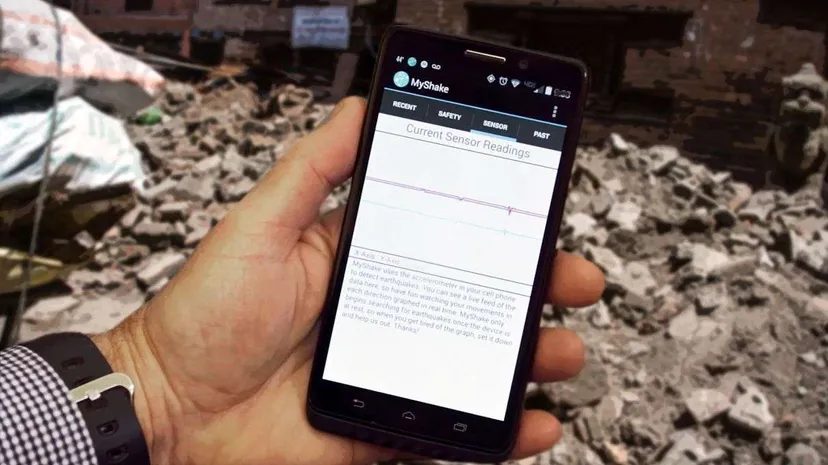
Imagine a global earthquake monitoring network powered by devices in your pocket instead of using expensive government infrastructures. That’s the ambitious idea behind the free MyShake app, developed by a team of researchers at the University of California, Berkeley. Its goal is simple but revolutionary: to strengthen the efforts of more than 80 countries that currently rely on a sparse network of only 150 earthquake stations to detect severe ground tremors.
The application uses the smartphone’s built-in accelerometer to register earthquakes in real time. It runs quietly in the background so the user won’t notice it, and it’s designed to minimize battery consumption. When the phone detects a vibration that matches certain earthquake conditions, MyShake immediately sends the data to the Berkeley Seismological Laboratory, including the exact GPS coordinates.
Why we need to strengthen traditional seismology
Why is this important? Traditional seismic observatories are not densely populated, especially in developing or remote areas. Gaps in coverage result in slower detection and fewer warnings for those affected. MyShake aims to solve this problem with crowd-sourced earthquake detection.
People living in earthquake-prone areas report earthquakes through social media such as Twitter, but this approach is unstructured and slow to verify. MyShake is changing the pipeline. The data is sent directly to seismologists in Berkeley, who can then send automated alerts via social media to people who have been affected. This process allows people to be alerted in seconds to minutes.
“Earthquake early warnings provide seconds to minutes of warning, allowing people to move to safety and automatically slow and stop traffic and other machinery.”
Those few seconds can be the difference between panicking and being prepared. They allow automated systems to stop trains, stop elevators and shut down industrial machinery before the worst impacts occur.
Networks are already developing
This concept is not just theoretical. The Android version of MyShake was released in English in February 2016 and has already attracted more than 170,000 users. In just three months of public use, the app’s network has recorded earthquakes across a wide geographic area, including Argentina, Chile, Japan, New Zealand and Oklahoma.
A large amount of data shows that smartphone-based seismic networks are possible. Qingkai Kong, a graduate student at the University of California at Berkeley who developed the app’s detection algorithm, called the work “a cutting-edge study that will change seismology.” He noted that while traditional monitoring stations have low density, the use of cheap smartphone sensors could lead to the creation of a high-density global monitoring network in the near future.
Increase your influence with language and platform
We understand that Earthquake has no language barrier, and our team is working quickly to make this tool available to even more people. Recently, a Japanese version of the Android app was released. UC Berkeley plans to release Spanish and Chinese versions soon, as well as an iPhone app. This extension is necessary to reach people in at-risk areas where English is not their primary language.
This technology is based on the widespread use of smartphones. Accelerometers are now standard in almost all mobile devices, so many resources remain underutilized. By leveraging this hardware, researchers are building real-time warning systems that are both cost-effective and scalable.
Alaska remains an earthquake-prone region of the United States, with at least one magnitude 7 earthquake occurring each year. The largest recorded earthquake in US history occurred in Prince William Sound on March 28, 1964, registering 9.2 on the Richter scale. For communities in these high-risk areas, the difference between knowing an earthquake is coming and feeling it first can be a big difference. MyShake offers a glimpse into a future where your phone doesn’t just tell you news, it helps you stay alive.