
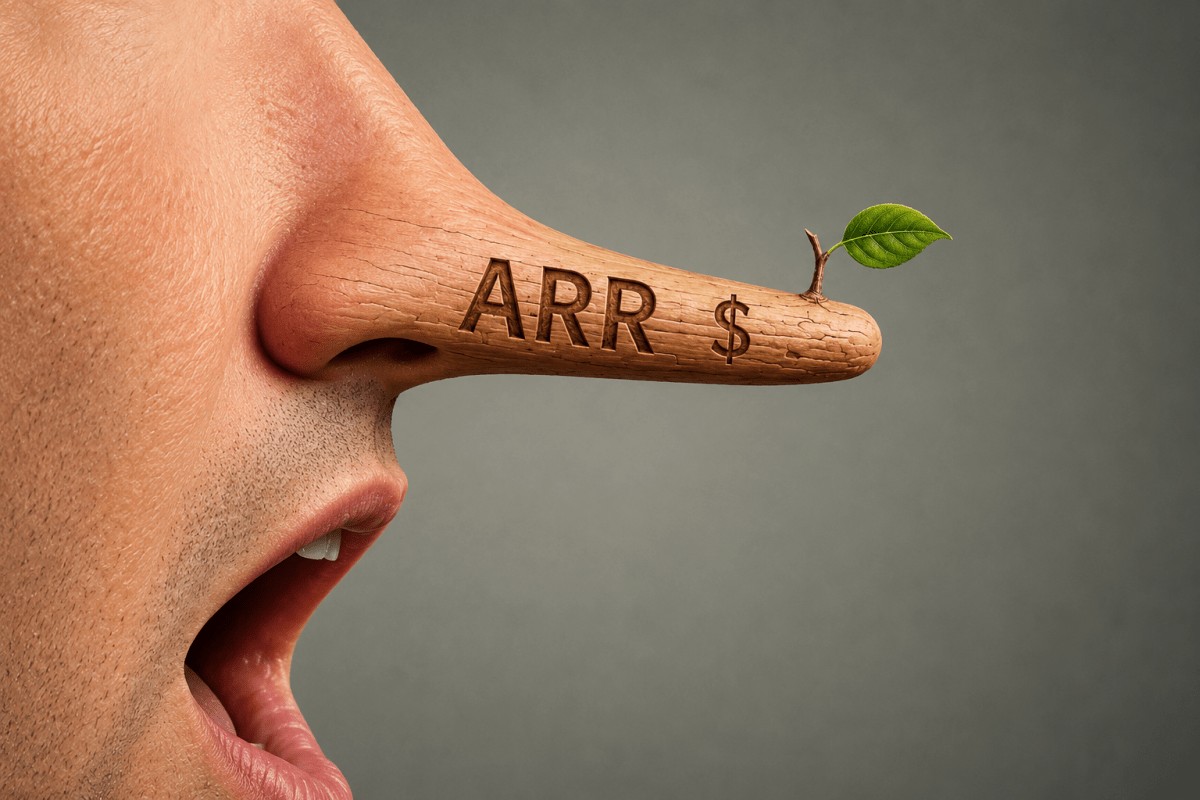
Last month, Scott Stevenson dropped a bomb on X.
He accused the AI world of running a massive scam.
Not a tech scam. A math scam.
He argued that the glowing revenue records being celebrated in every newsletter are built on sand. The biggest VCs in the room knew it. The journalists writing the headlines bought it. Stevenson called it what it was: a dishonest metric used to fake progress.
“The reason many AI startups are crushing revenue reports is because they are using a deceptive metric. The largest funds in the world are enabling this to buy PR.”
It hit a nerve.
Over 200 reshars later. High-profile investors jumping in. Founders getting defensive. Even Jack Newton of Clio had to jump into the ring. He said Stevenson was right about the “bad behavior,” linking to an old guide from YC founder Garry Tan that actually explains how to measure success without cheating.
But how deep does the rabbit hole go?
I talked to more than a dozen people who count money for a living. Founders. VCs. Finance operators who prefer to stay off the record because they’d get fired.
The answer is yes. It is common. And it is intentional.
Not quite real
Here is the trick. It’s simple, almost lazy.
Companies swap ARR for CARR.
Annual Recurring Revenue (ARR) has been the gold standard since cloud computing took over. It tracks active, paying customers under contract. Accountants ignore it, mostly. GAAP—the holy book of accounting—cares about what hit the bank account yesterday. ARR cares about what will hit it tomorrow.
That’s fine. It works.
Then you add “Contracted.”
Committed ARR (CARR) adds money from contracts that haven’t even started yet. No implementation. No product handed over. Just a signature and a handshake.
It’s squishy. Very squishy.
One VC admitted seeing a portfolio company where CARR was 70% higher than actual ARR. A chunk of that extra money never materializes. Ever. Customers bail. They go bankrupt. They just… vanish.
Bessemer Venture Partners tried to fix this back in 2020. They wrote that CARR needs to account for churn. They need to assume some customers will leave or downsize their plan.
Most companies don’t.
They count the revenue before the product works.
If implementation takes six months, those six months count as income in these fake numbers. If the client gets frustrated halfway through setup? They cancel. The money is gone. But the headline stayed up for three months.
There is a high-profile enterprise startup, one with serious name recognition, that claimed they passed $100M ARR.
It wasn’t true.
Only a fraction came from actual billing. The rest? Undeployed contracts. Some of them won’t be installed for years.
Worse?
A former employee at another company said they counted a year-long free pilot as revenue. Yes. Free usage counted as ARR. The board knew. A major VC on that board knew. They let it slide. Why? Because the public metric looked big.
“I’ve heard the same stories everywhere. VCs tell me the standards are chaotic right now.”
— Ross McNairn, Wordsmith
It’s not always fraud on a massive scale. Sometimes it’s smaller gaps.
$50M claimed. $42M real.
An $8 million difference. To the investors watching the dashboard, it’s noise. In the world of hyper-growth AI, $8M is a rounding error you’ll fix by Tuesday. They look at the public press release. They see the big number. They smile. They stay quiet.
The other lie
There’s a second trick. It wears the same face.
Annualized Run-Rate.
This one projects current income over twelve months. If you make $1 million in January, your “run rate” is $12 million a year.
That worked in SaaS when contracts were predictable.
It doesn’t work here. AI pricing is wild. It’s usage-based. Outcome-based. Volatile. Extrapolating a bad month looks fine on a pitch deck. Extrapolating it to the end of the year makes the company look like a unicorn.
It’s misleading by design.
Nobody denies it happens. It’s not new. But the hype has made it worse.
“The incentive structures have shifted,” said Michael Marks from Celesta Capital.
Why? Because the numbers demanded are impossible.
General Catalyst’s Hemant Taneja put it bluntly last September. Going from $1M to $27M ARR? Boring.
“We want 1 to 20. Then to 100.”
That pressure cooker creates distortion. Founders need to show velocity. Investors need to prove their bets were correct.
Scott Stevenson suspects the VCs are in on it.
“They need runaway winners. They need the press cycle. Inflated revenue fuels the fire.”
Jack Newton agrees. He sees investors ignoring the obvious fudge factors because it looks good for them. A shiny portfolio gets them more dry powder. It gets them into clubs.
Silence is complicity.
The coming crash?
Some investors argue that calling it out helps no one.
Letting a portfolio company wear a slightly oversized suit helps them hire better engineers. It scares away competitors. If the market thinks you are winning, you likely are.
“Everyone does it,” one VC admitted. “CARR becomes ARR. It’s the tax you pay to stay competitive.”
But those of us in the trenches see the cracks.
$100 million ARR in two years? Impossible. Not without lying.
“To anyone inside the industry, it feels fake. We read the headlines and cringe.”
— Alex Cohen, Hello Patient
Not everyone is dancing on this head.
Wordsmith’s McNairn refuses to play. He remembers the 2022 crash. He knows what happens when the music stops and you can’t pay rent.
“Exaggerating your multiple now creates a cliff later. It is terrible hygiene.”
He wants transparency. He wants the numbers to mean something when the hype fades.
The question is whether the rest of the room cares.
They care about the headline today. They care about the fundraise next month. The truth usually comes back later.
And later has a long way to go. 📉