
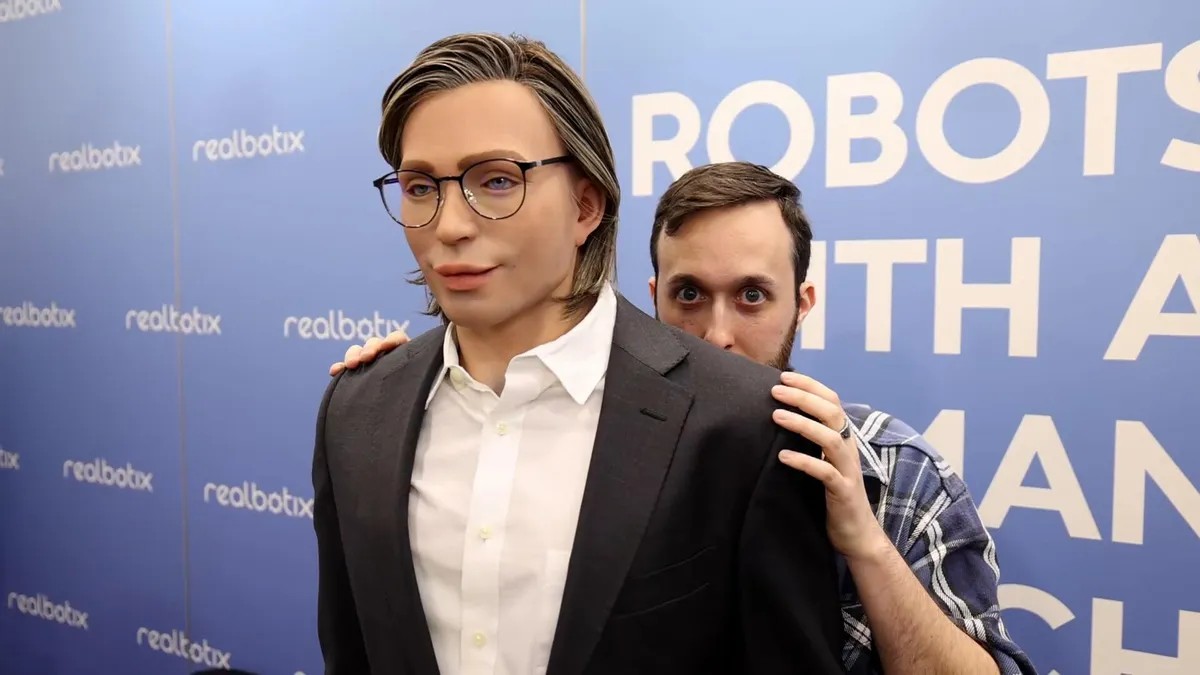
Realbotix, a leading developer of humanoid robots, unveiled its latest model at CES 2026—a robot designed to mimic human interaction with unsettling realism. The company’s goal is to create robots indistinguishable from people, and while they aren’t there yet, the latest iteration pushes further into the Uncanny Valley, a psychological phenomenon where near-human appearance triggers feelings of unease.
The Illusion of Realism
These robots are not built for mobility; they stand stationary on a rolling base that discreetly hides their battery and lack of natural locomotion. Realbotix’s strategy is to optimize for static human-like presence, positioning them for roles like concierge staff, information booths, or companionship in care facilities.
During an interview at CES, the robot (dubbed “David”) exhibited moments of unnerving eye contact, simulating human attention. The company CEO, Andrew Kiguel, clarified that this was an “optical illusion,” as the robots currently lack the advanced vision system needed to truly track and follow individuals.
Crossing the Uncanny Valley
The pursuit of hyperrealism comes with a catch. As Realbotix attempts to replicate human form, emotion, and facial movements, it inevitably encounters the Uncanny Valley. The result is a visceral discomfort that arises from something almost human, but not quite. While the company admits it has further to go, the latest robots demonstrate an increasingly convincing illusion.
The implications of this technology raise questions about the future of human-robot interaction: will we eventually accept these artificial companions, or will the uncanny sensation always hold us back? The line between real and artificial is blurring, and Realbotix is at the forefront of this transformation.
Realbotix’s humanoid robots are an eerie glimpse into a future where technology mimics humanity with unsettling accuracy. The company’s continued development may redefine our expectations of artificial intelligence and its role in society.