

The concept of social networking isn’t exactly new. It’s just the old-school practice of expanding your circle by meeting your friends’ friends, and their friends’ friends, repeated until you’ve lost track of the math. MySpace didn’t invent this. It didn’t even pioneer the web version of it. So why did it rack up more than twice the traffic of Google within just four years of launching in 2003?
By February 2006, the numbers were staggering. Fifty-four million people had profiles. Another 180,000 signed up every single day. Call it dumb luck. Call it a masterstroke of product design. Some just called it a predator’s playground. Regardless of the label, MySpace had become a phenomenon. But how did a simple profile site become worth $580 million to Rupert Murdoch? And what was the actual mechanic behind that explosive growth?
The Mechanics of the “Friend Space”
The magic of early MySpace was that your social graph started growing the moment you joined. You didn’t have to hunt. The platform did the heavy lifting.
It worked like this:
- You sign up. You build a basic profile.
- You invite your real-life friends to join. You also search for people you already know who are on the site.
- These contacts form your initial “Friend Space.”
- Here’s the twist. All the people in your friends’ Friend Spaces automatically become part of your network.
You didn’t need to manually add them. You didn’t need to send a request. They were just there. Suddenly, your connections had multiplied. You had access to more people than you did 15 minutes ago, without lifting a finger.
The Invisible Network
There was a catch, though. You couldn’t actually see the full extent of this web. The interface didn’t offer a collective view of your Extended Network. You couldn’t click a button and see every second- and third-degree connection laid out in a tree.
But the idea was there. The architecture implied a massive, dormant pool of potential contacts waiting to be tapped. It wasn’t just about who you knew. It was about who your friends knew.
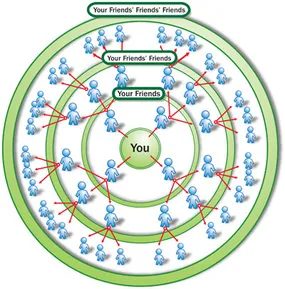

Let’s cut through the social graph nonsense for a second. Technically, you are already connected to everyone on MySpace. It’s a weird structural quirk: when you build a profile, the site’s co-founder, Tom Anderson, is automatically added as your friend. We are all tethered to each other through him.
You can try to trace your Extended Network by clicking through a friend’s Friend Space, then clicking their friend’s, and so on. It is the worst possible way to play “Six Degrees of Kevin Bacon” once you remove Tom from the equation. But you can request to add anyone. If they accept, you can send emails, instant messages, links to bands you found via MySpace Music, or whatever digital debris you want to share.
That is the networking layer. It’s basic. The real story is why this thing worked when every other social network collapsed. Business analysts love to write essays on the philosophy of it, but the reasons are grounded in something much simpler. The music connection changed everything.
The Indie Music Gateway
Early adopters weren’t random users. They were musicians. The founders were deep in the Los Angeles music scene, so it made sense that bands would flock to the platform first. Before social media was a utility, it was a billboard. Bands used the free profiles to post tour dates and talk to fans. It was a low-barrier entry point for exposure.
By 2004, this shifted from a contact list to a full-fledged Internet indie-music portal with the launch of MySpace Music. This wasn’t just a page; it was a streaming engine. Bands could upload tracks, stream them directly from their profiles, and let visitors download MP3s for free.
This was a massive lure. It pulled in more musicians, but more importantly, it pulled in the demographic that consumes music most voraciously: teenagers and twenty-somethings.
Accessibility Over Curation
What does that demographic want? Freedom. They want to express themselves without the strict gatekeeping that defined earlier internet spaces. MySpace leaned into this. The content moderation was minimal—basically just hate speech and extreme nudity. You’ll see skin, sure. That’s about it.
The site was accessible and customizable in ways that MySpace’s competitors couldn’t match. Users could inject music, video, graphics, custom fonts, and chaotic layout schemes into their profiles. They could hotlink graphics and video files hosted on other servers. This “do what you want, we don’t care” attitude was a magnet for 16- to 25-year-olds. (Their parents, naturally, were horrified.)
Crucially, you didn’t need an account to browse full profiles. You didn’t need a school affiliation, a company email, or a specific interest group. It was open to anyone who could read.
The User Base: Who Actually Shows Up?
If MySpace is for everyone, who is actually there? The core demographic is clear: sixteen- to twenty-five-year-olds make up the majority. Twenty-five percent of registered users are minors, aged 14 to 17. You have to be at least 14 to sign up, yet you’ll find 12-year-olds lying about their age because the site is simply the place to be.
But look deeper, and the network spans generations.
- 30-somethings use it because making friends post-graduation is surprisingly difficult.
- 50-somethings are jumping on the networking bandwagon to find business associates.
- 70-somethings are looking for dates.
It’s a catch-all. You’ll find poets publishing verses and authors taking book orders directly through their profile pages. The tech supports the content, not the other way around.
This broad utility explains why major artists like Madonna, the Black Eyed Peas, Audioslave, and Billy Corgan used the platform to communicate directly with fans and test tracks. And it explains why Rupert Murdoch recognized MySpace as a popular-culture magnet worth more than half a billion dollars.
Behind the Scenes: MySpace Technology
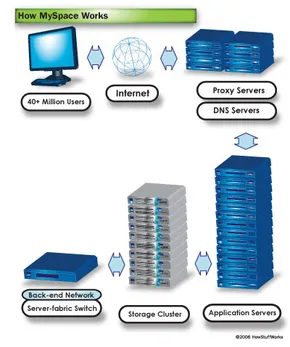

How MySpace’s Tech Stack Handled the Chaos
Let’s rewind to 2005. Rupert Murdoch’s News Corp. dropped $580 million on Intermix Media. The market saw this as a hostile takeover of MySpace. The logic was simple: you don’t buy a holding company for the paperwork. You buy it for the traffic. At the time, MySpace was pulling in over 15 billion page views a month. That is not just a website. That is a captive audience of young people with disposable income and too much free time. It was a potential consumer goldmine. But maintaining that kind of attention required infrastructure that looked less like a typical blog and more like a military-grade operation.
The DNS and Proxy Layer
When you type myspace.com into your browser, something has to tell your computer where that site actually lives. That is the job of Domain Name Servers (DNS). MySpace didn’t build its own DNS servers from scratch. That would be inefficient. Instead, they used a “Managed DNS” service called UltraDNS.
UltraDNS runs on a massive network of servers. It distributes user IP requests based on which servers are currently available. The goal? Congestion control. By spreading the load, they reduced slowdowns and DNS errors during peak hours.
Sitting between you and MySpace’s core servers are proxy servers. These things serve up cached content. If you’re looking at a profile, the proxy might already have that page stored locally. It cuts down on redundant requests to the main application servers. Less traffic hitting the backend means less congestion overall.
The Engine Room: Application Servers and Databases
For the heavy lifting—email, instant messaging, blogging—MySpace leaned on BlueDragon.NET. This software runs CFML (ColdFusion Markup Language) code on Microsoft IIS servers. It’s a specific stack. Not everyone uses ColdFusion, but it worked for the site’s needs at the time.
Then there is the data. MySpace sits on a 20-terabyte scalable cluster of Isilon IQ 1920i servers. To put that in perspective, a terabyte is one trillion bytes. The cluster stores users’ uploads: images, videos, songs. The hardware runs on 3.2-GHz Intel Xeon processors. There are 10 server nodes, each holding 1.92 TB.
The nodes don’t just sit there. They talk to each other via InfiniBand architecture. This establishes point-to-point, serial connections between servers. The result? Data-transfer speeds hovering around 3 GBps. Fast. Very fast.
Back-End Connectivity
The back-end of this operation is an InfiniBand server switch. A server switch facilitates communication between multiple servers on multiple platforms. In MySpace’s case, it connects all the internal servers and links them to external servers that deliver content to you.
The Equinix Exchange central server switch in Los Angeles hosts MySpace’s content delivery. Equinix Exchange is an Ethernet-based peering service. It connects MySpace to top-tier Internet backbones through a single hub. Think of it as a “fabric” of server switches connecting all Equinix networks. Content travels from MySpace through any of these connected networks, choosing the most efficient route based on available bandwidth.
It is a setup designed for maximum efficiency. Load distribution is key. Minimize downtime. Reduce delays.
But let’s be real. It wasn’t perfect. As of February 2006, Alexa ranked MySpace in the bottom 25 percent of websites by speed. The author encountered numerous error messages while navigating the site. Why? Because MySpace had more traffic than Google but significantly less capital—at least before Murdoch’s check cleared. Delivering speedy, round-the-clock content to millions of simultaneous users costs a fortune.
Two major infusions of cash happened before News Corp. took over. In 2003, Intermix Media bought a 53% stake in MySpace for an undisclosed amount. In 2005, Redpoint Ventures bought its 25% stake for $11.5 million. With News Corp. in charge, the assumption was that MySpace would finally have the budget to buy better toys and improve speed.
The Revenue Model
So, how does the site pay for itself? Advertising. That is the only revenue generator that doesn’t cost stock. It is advertiser heaven.
The core user profile is web-surfing 16- to 25-year-olds. That demographic is the holy grail for advertisers. According to Alexa, MySpace hit a peak of 16 billion page views in January 2006. That is a staggering number of ad impressions. Estimates suggested the company pulled in $30 to $40 million in ad revenue in 2005 alone.
The Origin Story
MySpace was founded in 2003 by Chris DeWolfe and Tom Anderson. It started as a social networking site, modeled loosely after Friendster. But Friendster had a critical flaw. It couldn’t handle the traffic. During peak hours, the site slowed to a crawl. Or DNS errors blocked access entirely.
Users got fed up. They migrated to MySpace through word of mouth. It started with the founders’ friends and employees. Then came media promotion via Intermix, which held a controlling share. The move worked.
Anderson and DeWolfe noticed something specific. Musicians and music fans were using MySpace more than any other group. They capitalized on this. They created MySpace Music. Traffic skyrocketed. The platform shifted from a generic social network to a music-driven community.
And now, let’s look at the interface. The author’s dog, Ellie, apparently wants to create a MySpace profile. To expand her social network. One wonders if she can handle the wait times.
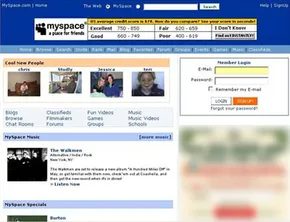

Ellie is broke. That isn’t a dealbreaker. MySpace is completely free, so she doesn’t need a credit card to get in the door.
What happens next is strikingly efficient. The entire registration process clocks in at roughly two minutes. You aren’t filling out pages of legal jargon. You’re just punching in the basics on a simple form.
The Minimalist Sign-Up Flow
The profile creation is stripped down to essential data points. Ellie types in her name. She enters an email address. She picks a password. It’s that simple.
Location data is gathered next, but with a caveat. If you’re in the United States, Canada, or the United Kingdom, the form asks for a postal code. Users in other regions skip that field. Gender and birth date follow immediately after.
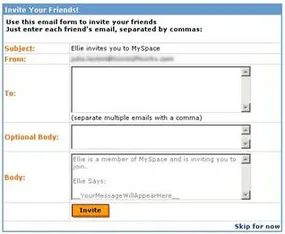
There’s a quick nudge to upload a photo. The site wants visuals. It also prompts you to invite friends to join. This is where the network effect begins, even before you’ve built your first post.
The barrier to entry was virtually non-existent.
This low-friction approach was intentional. By removing financial and time barriers, the platform aimed to capture users who were otherwise skeptical of online social circles. The design prioritized speed over depth. You could be in, and connecting with others, before you even thought about what to say.
It’s a different model from what we see today. Modern platforms often demand more data upfront or rely on algorithmic nudges to keep you engaged. MySpace relied on the raw utility of free access and immediate peer connection.

Ellie’s MySpace Setup: What Actually Comes With the Account
Ellie just joined MySpace. She’s not lurking anymore. Her profile is live, and the default toolkit is already installed.
You get the basics first. An inbox for messages. A blog section for writing. Photo storage that actually works. A custom URL if she bothers to pick a username that isn’t taken. An address book to keep tabs on friends. And then there’s the rest. The features that fill up the screen but rarely get clicked.
It’s the standard package. Every new user gets this exact same stack of digital real estate.
Ellie has the full suite. Inbox, blog, photos, URL, contacts. The rest is up to her.
Why does this matter? Because MySpace wasn’t just a site. It was a identity builder. The URL was the badge. The blog was the voice. The photos were the proof. You curated yourself.
Ellie can tweak the CSS later. Change the colors. Add music. Hide parts of her profile. But the foundation is set. The hooks are in place.
Now she has to decide what to post. And who to invite. The infrastructure is there. The content isn’t.
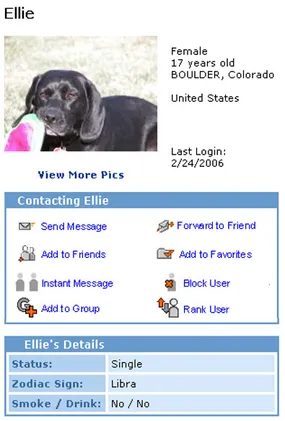



Ellie’s social graph just got a serious upgrade. Thanks to Tom Anderson—MySpace’s president and co-founder—she’s no longer starting from zero. The site’s architecture now allows users to invite existing contacts to join while simultaneously search ing for friends who have already claimed their profile.
The friction of finding people is largely gone. You can look them up by name or email, but the real power move is the bulk import. MySpace lets you pull your entire address book from major providers like Yahoo!, Hotmail, AOL, and Gmail. The system scans these lists automatically, flagging any matches that already have a MySpace account. It’s a shortcut that turns a cold start into a warm network.
Finding Old Connections by Affiliation
Name searches are fine, but they don’t capture the serendipity of the offline world. MySpace offers deeper filters for new connections. You can browse by school affiliation, hunting down classmates from high school or college. Colleges actually have dedicated sections on the platform, making it easier to triangulate your circle. Business affiliation is another lever, allowing you to reconnect with former colleagues or industry peers.
Browsing by Criteria
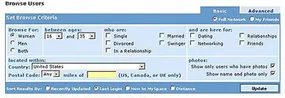
If you prefer a more exploratory approach, Ellie can browse by specific criteria rather than targeting individuals. This method relies on the platform’s categorization of users, letting you discover profiles based on shared interests, locations, or demographic markers. It’s less precise than an email import, but it opens doors to people you might not have known to search for.



The Mechanics of Connection on MySpace
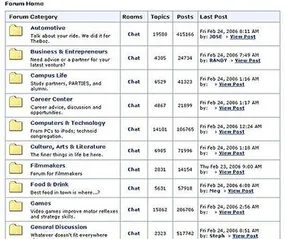
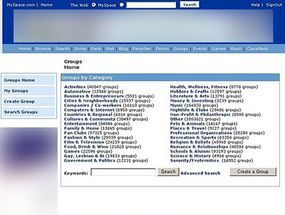
The platform’s social architecture was built on participation. Users didn’t just lurk; they populated MySpace forums, engaging in threaded discussions that often spilled over into personal connections. Alongside these public debates, the site offered groups tailored to niche hobbies, shared interests, or specific subcultures. This categorization allowed for targeted discovery—you weren’t just browsing a void; you were filtering by taste.
Once the right profile popped up, the friction vanished. There was no application process, no waiting game. Just a click on the Add to friends button located directly on the user’s profile page. Instant status change. Digital proximity achieved.
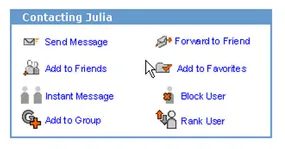

The notification pops up. Ellie wants to add you to her Friend Space. You click approve, or you don’t. If you let it through, you appear in her circle automatically. Simple.
But MySpace was never just about the friend list. It was a utility belt for self-expression that happened to include social networking. You could write a blog right there. You could rank photos of other users, which was either a fun game or a source of drama depending on who was watching. You could even grade your college professors. Yes, really. The platform hosted local events, allowed classified ads to go up, and offered a suite of games for passing the time.
Yet none of that rivaled the gravity of one specific feature.
Why MySpace Music Dominated
MySpace Music was not a side project. It was a destination. And it was the first time a website successfully remade the music industry on a massive scale. Other sites had tried. They had failed. MySpace didn’t.
It gave artists a space that didn’t require a record label. It gave fans a way to discover music that wasn’t filtered by traditional radio programmers. The infrastructure was there. The community was ready. The result was a shift that rippled through the entire industry.
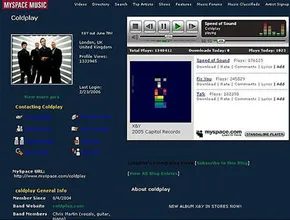

The MySpace Music Phenomenon: Bridging the Gap Between Stars and Unsigned Bands
You might remember it as that dusty corner of the early web, but MySpace Music wasn’t just a profile page. It was a dedicated ecosystem, comparable to eBay Motors within the broader eBay universe, designed specifically for audio distribution and fan engagement. It democratized release strategies. Established acts and unsigned bands used it with equal fervor to push tracks out into the void and connect directly with listeners.
The strategy was simple: drop singles or full albums online before hitting physical stores. This pre-release window became a standard marketing tactic. Major names like REM, Franz Ferdinand, Billy Corgan, the Black Eyed Peas, and Nine Inch Nails all leveraged this platform to premiere content. It wasn’t just about hype; it was about controlling the narrative of a release cycle.
But the real scale of the platform lay in its sheer volume. Nearly 600,000 bands had created profiles. The hierarchy of fame was flattened. On the same page, you could find Coldplay standing shoulder-to-shoulder with Rusted Halo, an unsigned act from Chesterton, Indiana. The digital stage didn’t care about your record deal. It only cared if you had a track and a fanbase willing to click play.
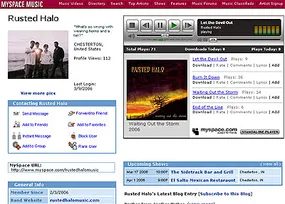

Local bands used to rely on word of mouth. It was a slow burn. You played the dive bar. You handed out flyers. You waited for the next town over to hear about you. MySpace broke that geographic lock. Suddenly, a San Francisco group could appear in the Friend Space of a listener in Germany within minutes. The distance collapsed.
The platform offered a toolkit that felt tailored for musicians who lacked a label. It wasn’t just a social network. It was a distribution channel. The interface included a built-in music player. Fans could rate songs. They could leave reviews. There were rankings based on page views. Show listings were tied to location. Music videos uploaded by artists sat right there in the feed.
But the real asset wasn’t the player or the reviews. It was exposure.
Why did MySpace succeed where others had failed? The music industry had long dreamed of a site where artists could bypass the gatekeepers. MySpace became that place. Some blame its initial roots in the Los Angeles music scene. Others point to the sheer volume of traffic. The custom music functions likely played a part too. But the result was clear. Unsigned musicians found a direct line to an audience.
No one is entirely sure why MySpace has become what other sites have dreamed about — a place where musicians can get their music out there in a major way without the help of a label.
The barriers to entry dissolved. You didn’t need a record deal. You needed a connection. The platform turned the internet into a global open mic. For a brief window, that was enough.


The music industry is shifting, and it’s not subtle. Bands like Hawthorne Heights, My Chemical Romance, and Arctic Monkeys didn’t just get discovered; they built empires online. MySpace became the launchpad. Through guerrilla marketing tactics, Arctic Monkeys hit No. 1 on the UK Charts before their debut album even existed. My Chemical Romance moved over a million copies of its 2004 debut. Hawthorne Heights sold half a million of theirs.
Why does this matter? Leverage. These artists didn’t walk in begging for a contract. They walked in with a fanbase and sales data. An A&R rep sitting in a club sees potential. An artist with a million online fans sees a business partner. The power dynamic flipped.
Then there’s Hollywood Undead. A little-known California group. They hit MySpace in June 2005. Within a week, they were No. 4 on the music chart. 65,000 friends. Six months later, they signed with MySpace Records.
How MySpace Records Finds Talent
MySpace Records isn’t just a label. It’s a hybrid. A partnership between MySpace and Interscope Records. Indie spirit, major-label retail muscle. Tom Anderson, MySpace president, runs creative direction and A&R. The hook? The label doesn’t scout bars. It scours the rankings. User feedback drives the roster.
The first release was MySpace Records, Vol. 1 in November 2005. Unsigned artists. Signed artists. Everyone with a profile. Hollywood Undead’s debut was slated for 2006.
But speed brings risk. The platform’s explosive growth sparked serious privacy concerns. Parents. Teens. Strangers. How do you secure a network that open?
MySpace Safety
The platform had to answer for itself.


The Predator Problem and the Verification Trap
Seven nonviolent sexual assaults on minors. One murder. All linked to initial contact on MySpace. These aren’t just statistics. They are the harsh reality of what happens when anonymity meets youth.
Predators don’t care about the platform. The internet is a hunting ground by default. Anonymity is the weapon. But the press focused on MySpace for a simple reason. Its user base was overwhelmingly under 18. And the site refused to verify who they really were.
The rules looked good on paper. You had to be 14 to join. If you were under 16, only your “Friend Space” contacts could see your profile. It sounded secure. It wasn’t. Kids lied about their age. So did the adults looking for underage victims. The system was broken from the start.
MySpace faced a classic Catch-22. Its success relied on an open, “whatever” attitude. Strangers could connect easily. Identity verification would stop the predators. It would also stop the kids lying about their age. Worse, it would annoy the legitimate users. Who wants to provide a credit card or social security number just to hang out online?
The company claimed to care. One-third of its 175-person workforce policed profiles. They looked for age discrepancies. They checked if photos matched stated ages. They hunted for inappropriate material. Did this start before the media called it a “parent’s nightmare”? No one knows. But the effort was visible.
The Safety Tips section offered standard advice. You could find similar warnings on any dating site. The message was clear.
- Never post personal details. Addresses. Phone numbers. Keep them private.
- Meet in public places. Only if you know someone in real life should you meet elsewhere.
- Watch for scams. Phishing. Identity theft. Surf with caution.
- Report suspicious behavior. Save the messages. Police can trace them if necessary.
The guidance was sound. It was also largely ignored.
Security Infrastructure and Public Relations
April 11, 2006. MySpace announced a major shift. They hired a former federal prosecutor as their first chief security officer. This wasn’t a PR stunt. It was an operational change. They also partnered with WiredSafety.org to tighten procedures.
The cat was out of the bag. Corporations don’t want their image to be “a breeding ground for predators.” It’s like catching a supermodel with a straw in her nose. Nobody is surprised. The proof is the problem. MySpace needed to clean up its act.
They took action. They banned 29,000 registered sex offenders. That is a significant number. It signaled that the company was no longer turning a blind eye. But banning known offenders doesn’t stop new ones. It doesn’t stop the liars. It doesn’t solve the core tension between safety and growth.
The site was too popular to ignore. People wanted to take their MySpace everywhere. Enter MySpace Mobile. The platform was expanding. And with expansion came new tools. MySpace IM was coming next. The infrastructure was growing. The risks were rising.
The digital playground was getting more crowded. And the predators were adapting.
Beyond the Profile
MySpace wasn’t the only option. Users had choices. The social networking landscape was fragmenting. People were looking for alternatives. Or adding to their existing networks.
- Facebook was rising. Younger. More exclusive.
- Friendster was fading. Clunky. Outdated.
- LinkedIn was for work. Professional. Serious.
- Orkut was popular in Brazil. Regional. Niche.
- Ryze and Tribe were smaller. Community-focused.
- TagWorld offered different social mechanics.
The market was crowded. MySpace had the volume. But volume brings baggage. The safety issues were real. The solutions were incomplete. The tension between openness and security remained unresolved.
MySpace tried to balance the books. They hired security experts. They banned offenders. They updated rules. But the fundamental problem persisted. Anonymity is hard to kill. And the users loved their freedom.
The mobile app was the next step. Connectivity was the goal. But can you secure a connection that thrives on anonymity?
The answer wasn’t in the code. It was in the culture. And that is much harder to fix.


MySpace Mobile
MySpace didn’t just explode into the zeitgeist in 2003; it sustained the fire by constantly pivoting to meet user demand. The strategy was simple: if you weren’t at your desktop, you weren’t on MySpace, and that was a problem they couldn’t afford. The solution came in December 2006, when the platform partnered with AT&T (then Cingular Wireless) to drag its social networking features into the pocket-sized era.
The entry point was basic: MySpace Mobile Alerts. These were SMS notifications sent to your handset whenever your profile got updated. The alerts themselves were free from MySpace, but your carrier’s standard text messaging rates still applied. If you wanted more than just notifications, there was a paid tier. AT&T subscribers could pay $2.99 a month for the full MySpace Mobile service. This required downloading a Java application that unlocked photo uploads, blog posting, friend browsing, and email access.
Don’t let the flat monthly fee fool you into thinking it was cheap. Data charges from your carrier still kicked in. Uploading a photo from a 1.2-megapixel camera could easily run you $1.50 in data overages. If you were on a tight budget, mobile MySpace was a budget-buster.
For those with Helio devices, the deal was sweeter. Backed by EarthLink and SK Telecom, Helio offered a custom MySpace application. Most Helio plans included unlimited data, meaning you could use MySpace Mobile without extra per-use charges. It was one of the few ways to access the site without fearing a surprise bill at the end of the month.
MySpaceIM
People want immediate gratification. Waiting for a profile refresh to see if a friend replied felt archaic. To keep its millions of users from migrating elsewhere, MySpace launched MySpaceIM on June 20, 2007. Before this, users were stuck using third-party clients like AOL Instant Messenger (AIM) to chat. Now, the platform had its own dedicated client.
MySpaceIM wasn’t just a text box. It came with an integrated music player, adjustable conversation views, and a skinnable interface that let you customize backgrounds and avatars. You could import your existing friends list, making the switch painless. It even supported “zaps”—sound bites you could send to friends. Power users appreciated the one-click login and instant alerts for new messages, friend requests, and comments.
The development team didn’t stop at their own client. Cerulean Studios, which built the popular Trillian IM client, released Trillian Astra to support MySpaceIM. They were also working on a Pidgin plug-in that connected MySpaceIM to the libpurple library. This was an attempt to iron out bugs and improve stability after the initial test launch. If you wanted to run the native MySpaceIM client, you needed Microsoft Windows 98, 2000, XP, or Vista, along with Internet Explorer 5.0 or higher.
MySpace Impact
Chatting with friends was only half the battle. MySpace also wanted to help users engage with real-world issues. In 2007, they introduced MySpace Impact. This feature allowed both individuals and organizations to post information about various causes. The goal was to spread awareness and garner support for social and political movements. It was an attempt to turn the platform’s massive reach into something with tangible real-world consequences.


Politicians have long screamed into the void, begging Gen X and Millennials to care about civic duty. Polls consistently showed that yelling didn’t work. So when MySpace launched MySpace Impact, it wasn’t just another feature drop. It was a pivot. The social network decided to tackle political apathy head-on, focusing specifically on American politics despite its global user base.
This wasn’t a cash grab. In an era where every click had a price tag, MySpace Impact stood out because it prioritized education and dialogue over revenue. It was one of those rare, almost selfless moves in a platform designed for vanity metrics and ads.
The Mechanics of Influence
The core engine of this initiative was the MySpace Impact Award. Think of it as a monthly spotlight for good deeds. The awards were split into six distinct categories:
- International Development
- Poverty Relief
- Social Justice
- Health and Safety
- Environmentalism
- Community-building
Here is how it worked. Users nominated organizations. Then, the community voted. One winner took home the prize each month. The stakes? Not millions, but meaningful exposure.
Take June 25, 2007, for example. ONE.org: The Campaign to Make Poverty History won the Poverty Relief award. They didn’t just get a trophy. They received $10,000, a prime link on the Impact page for a full month, a shout-out in the newsletter, and a MySpace-wide bulletin. For a nonprofit, that visibility is worth more than the cash. It drives traffic. It drives donations. It drives change.
Presidential Focus
If you wanted to know where your favorite candidate stood, you didn’t need to read a 40-page whitepaper. You just went to MySpace.
The Presidential Focus section aggregated links to every major candidate’s MySpace page. Whether it was Barack Obama or John McCain, the profile served as a hub for their stances on the issues that actually kept people up at night: education, health care, immigration. It was direct. No intermediaries. Just the candidate and the voter.
They also posted videos and links to political events globally. The goal was simple: keep users informed. If you’re scrolling through your feed, you should see news, not just cat pictures.
The Registration Pipeline
But the real power move? The voter registration link.
Young people were on MySpace. Politicians wanted young people to vote. MySpace put the tool right in the hand of the user. It removed friction. If you were already logged in, registering to vote was just a click away. It turned passive interest into active participation.
This was the holy grail for civic engagement platforms: lower the barrier to entry. By integrating voter registration directly into the social experience, MySpace wasn’t just talking about democracy. It was facilitating it.
The question isn’t whether it worked perfectly. It’s whether it set a precedent. Later platforms would try to replicate this, often clumsily. But MySpace Impact showed that social networks could be more than echo chambers. They could be town squares.
Even if the hype faded, the infrastructure remained. And for a while, that was enough.


MySpace didn’t just get big by letting users post pictures. The real engine was video. By mid-2007, the social network had morphed into a video hub. They launched MySpaceTV.com to capture that traffic. It wasn’t just a US-only play. The platform went international, rolling out in 15 countries and seven languages.
The content mix was specific. You had user-generated clips, sure. But also curated programming. Sony Minisodes were a big deal—five-minute cuts of classic TV shows. MySpace didn’t build this library alone. They signed deals with Reuters, the New York Times, and National Geographic. High-quality journalism on a social site? That was the pitch.
Customization and Access
Users could build their own channel pages. This wasn’t just a profile update. You could save videos, leave comments, and curate playlists. These channels linked back to your main MySpace profile. It kept you in the ecosystem.
Access had a barrier. Non-members could browse. If you wanted to upload? You needed an account. Registered users got the tools. The interface offered:
- Video charts to track trends
- Categorical organization for easier browsing
- Featured channels highlighted by editors
- Featured videos rotating on the homepage
- A hot video of the day to drive engagement
News Corp owned MySpace. That mattered. They partnered with NBC Universal. The goal was simple. Air TV shows and movies over the internet. Do it legally. Do it profitably. MySpaceTV was the outlet for this deal.
The YouTube Comparison
Critics were quick to point out the resemblance. MySpaceTV copied YouTube’s format. Closely. The layout felt familiar. The organizational method was nearly identical. Some said it was intentional. Copy the winner. Get the success. Others argued there was no other way. YouTube had optimized the experience so well that deviation seemed risky.
Both sites functioned similarly. The difference was audience. Many web video fans were already on MySpace. If you were there, you stayed. The network effect was the deciding factor.
The site not only features user-generated content and other online video programming, but also Sony Minisodes.
The partnership with NBC Universal was supposed to help MySpace surpass YouTube and Yahoo. It was a heavy-weight bout for video dominance. But the copying debate lingered. Was it innovation or imitation?
On the next page, we’ll learn about MySpace’s expansion into movies, news and comedy.
Other MySpace Site Sections

Niche Content Hubs on MySpace
MySpace Movies
For cinephiles, MySpace Movies was less of a standalone utility and more of an ecosystem trap designed to keep you in the MySpace silo. The section aggregated everything from new release data to behind-the-scenes clips. It wasn’t groundbreaking tech. You could get showtimes and buy tickets elsewhere. But the integration was the point. Users could browse photos, check cast and crew details, and see which films were currently trending in box office rankings.
The real hook? The social layer. Every film had its own MySpace profile. Fans didn’t just watch movies; they added them to their friends list. It was a quirky behavior, but it worked. By embedding these profiles, MySpace ensured that movie talk happened on its servers, not on IMDb or Rotten Tomatoes.
MySpace News
When MySpace News launched in April 2007, it tried to occupy a middle ground in the information economy. It sat somewhere between the algorithmic sorting of Google News and the democratic voting system of Digg. The aggregator pulled headlines from established news outlets and personal blogs alike. The mechanism was simple: users submitted URLs, and the community voted on their quality.
This wasn’t just for clickbait. The platform allowed filtering by topic—sports, politics, travel—and by location. It felt like a serious attempt to mature the site’s demographic. As the early adopters aged, the demand for real media, not just profile updates, grew. MySpace News was the company’s bid to become a portal for all web content, serious and otherwise. It wasn’t the most visited section, but it signaled a shift toward utility over pure socialization.
MySpace Film
Amateur filmmakers found a strange sort of nirvana in MySpace Film. The platform offered tools to promote, share, and critique work. The homepage featured rotating banners that highlighted user-generated content. For an indie director, landing on that banner meant global exposure that traditional distributors rarely offered to novices.
The section included a “Festival Focus” hub linking to independent film festivals and a job board for industry roles. There was also a User’s Choice Award, a digital accolade that carried real weight. In June 2006, Matt Riddlehoover won for his short film To a Tee. The victory didn’t just give him a badge; it landed him quotes in Filmmaker magazine and broader media attention. The social network had become a legitimate distribution channel.
MySpace Comedy
Comedy followed a similar arc. MySpace Comedy launched in the summer of 2006, offering a space for both pros and open-mic amateurs. The site listed upcoming tour dates, featured improv picks, and hosted sketch comedy archives. While it leaned toward commercial content, it served as a critical networking tool for beginners.
Dane Cook remains the case study here. He built his profile in late 2003, long before the Comedy section officially existed. By posting daily bits and linking to his personal site, he cultivated over two million “friends.” MySpace allowed him to bypass traditional gatekeepers. He didn’t need a club owner’s permission to reach an audience. He just needed Wi-Fi and consistency.
The platform’s various channels—movies, news, film, comedy—each tried to solve a different problem: discovery, aggregation, exposure, and connection. They failed to save the company, but they proved that social networks could host vertical-specific media. The experiment ended, but the model of community-driven curation survived. We still vote on content. We still look for indie voices. We just do it elsewhere now.
The Infrastructure Behind the Chaos
MySpace didn’t just become a cultural juggernaut by accident. It happened because the company made specific, high-stakes bets on technology that most other social networks ignored or delayed. While competitors were still figuring out how to handle a few hundred thousand users, MySpace was dealing with millions. The difference wasn’t just in the code; it was in the physical and network layer. They needed speed, storage, and bandwidth that didn’t break under pressure.
The story starts with how people actually found the site. For years, MySpace relied on UltraDNS to manage its domain name infrastructure. This wasn’t a minor detail. When millions of users typed “myspace.com” into their browsers simultaneously, a slow or failing DNS resolver meant a broken experience. By choosing a robust DNS provider, MySpace ensured that the gateway to their chaotic, user-generated content remained open and fast. If the door didn’t open, the party never started.
Storage Scaling for Media Heavyweights
But finding the site was only half the battle. Keeping it running required massive amounts of disk space. MySpace sites were heavy. Users uploaded photos, blog posts, and eventually, music and video. This content didn’t vanish. It sat on servers, eating up storage.
In the mid-2000s, the standard approach was expensive and rigid. MySpace opted for a different path. They deployed Isilon Systems clustered storage. This was a move away from traditional SANs (Storage Area Networks) toward a scalable, clustered approach. Why did this matter? Because user growth wasn’t linear. It was exponential.
“Isilon Systems Clustered Storage Deployed by MySpace.com to Manage Astounding User Growth and Media Consumption.”
This technology allowed MySpace to add storage nodes as needed without downtime. It wasn’t just about having room for files; it was about maintaining read and write speeds as the database grew. If the storage layer lagged, the site felt sluggish. If it felt sluggish, users left. The Isilon deployment was a direct response to the need for elastic scalability. It handled the “astounding user growth” that other platforms struggled to accommodate.
Network Connectivity and Peering
Storage is useless if the data can’t reach the user quickly. MySpace knew that latency kills engagement. To combat this, they engaged with Equinix, one of the world’s largest data center providers. The strategy was peering.
Peering is a direct connection between two networks. By placing their servers inside an Equinix data center, MySpace could connect directly to major internet service providers (ISPs) and content delivery networks. This bypassed the public internet’s congested choke points. The result? Faster load times for users on AOL, Comcast, and other major ISPs.
This wasn’t just about speed. It was about reliability. When traffic spiked during major events or viral trends, the direct peering links absorbed the load without collapsing. The decision to enhance network connectivity via Equinix was a business move disguised as infrastructure work. It kept the site up when others might have gone down.
The Business of Bandwidth and Video
The infrastructure supported a shift in content type. MySpace wasn’t just a social network; it became a media platform. MySpaceTV was launched to compete with YouTube. This required a new kind of infrastructure. Video files are large. Streaming them in real-time demands significant bandwidth and efficient caching strategies.
Sources from the time note that MySpace was adapting quickly. They added film to music, creating a hybrid media hub. This shift put immense strain on the backend. The Isilon storage and Equinix peering worked in tandem to handle the video load. Without this robust backend, the push into video would have been a technical failure. The technology enabled the business model.
Security and the Dark Side
No discussion of MySpace’s infrastructure is complete without mentioning the security challenges. The open nature of the platform was its strength and its weakness. The site became a target for predators and spammers.
There were reports of programmers finding sex offenders on the platform. This wasn’t just a moral failure; it was a data management issue. How do you identify and ban users across a massive, distributed database? MySpace eventually took steps to block sex offenders, a process that involved scanning profiles and cross-referencing data. This required computational resources and efficient database querying. The infrastructure had to support not just content delivery, but also security monitoring and enforcement.
The Legacy of the Stack
MySpace’s technical choices were pragmatic. They didn’t invent new hardware. They assembled existing technologies in a way that prioritized scale and speed. The combination of UltraDNS, Isilon storage, and Equinix peering created a backbone that could handle the sheer volume of user activity.
It’s a reminder that the user experience of a social network is determined long before the front-end design is finalized. The real work happens in the data centers. The smooth scrolling, the quick photo uploads, the instant page loads—all of these are downstream effects of good infrastructure.
MySpace eventually sold for $580 million. That valuation was based on user numbers and ad revenue. But those numbers were only possible because the technology held up. When the hype died down, the infrastructure remained. It’s a lesson in scalability. You can build a great interface, but if your DNS is slow, your storage is full, and your bandwidth is congested, you don’t have a platform. You have a broken link.
The specific vendors mentioned here—Isilon, Equinix, UltraDNS—were chosen because they solved immediate problems. They didn’t have a 10-year roadmap. They had a “make it work now” mandate. That urgency defined the era.